 DOWNLOAD
Aluminum and steel manufacturers use mass flow controllers to inject purification, stirring and shielding gases into their melting, casting and annealing processes. Precise, automated gas flow control reduces toxic emissions and material costs. 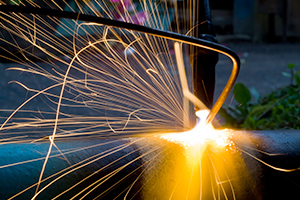
Final purification of aluminum is accomplished by bubbling a mixture of argon and chlorine gases through the molten metal. This process separates sodium and calcium salts, which are skimmed off in the filter box. The ratios of bi-gas and tri-gas mixtures are critical in molten metal treatment, particularly with the use of such gases as SF6.
Excess gas delivery can cause inclusions in the finished product and result in higher emissions of costly and toxic gases. Insufficient gas delivery can result in clogging of the refractory components.
SIERRA’S SOLUTION
Sierra’s SideTrak® 840 allows the operator in a fully automated mixing station to simply push a button to flux the molten metal. A trickle flow of gas can also be set to ensure that sludge does not build up in the bubbling mechanism. SideTrak controlled mixing equipment provides accurate and repeatable delivery of these treatment gases, even with pressure fluctuations in the carrier gas.
In stirring applications, precise gas delivery made possible by the 840 ensures continuous and uninterrupted production of a high-quality product. Excess gas usage is known to cause plugging of the nozzles and/or plugs, caused by low temperature gases chilling the molten metal to a solidifying temperature. In the steel pouring system, injection of argon or nitrogen during the casting process prevents re-oxidation and clogging of refractory components with aluminum oxide.
Generally, gas is injected at several points in the slide gate: through the upper nozzle, upper plate brick and submerged entry nozzle. Gas sealing can also be used around the plate brick mating surfaces and the lower nozzle/SEN joint to assure that there is no air aspiration during casting. In the annealing process, 840s are used to control the flow of nitrogen from on-site gas plants, to allocate costs and identify "wasters", such as leaks in the line or a purge left on to a non-operating annealing oven.
Here’s what makes Sierra’s SideTrak 840 an ideal choice:
- One of the worlds most dependable analog mass flow controllers
- Precise primary calibration to measure any clean, dry gas with low pressure drop
- Highly accurate for oxygen, mixtures, toxics, corrosives and combustibles
- Widely used in process control, leak detection, gas distribution and scientific research