|
Santa Cruz Wastewater Replaces Older Technology with Sierra
For Santa Cruz Wastewater Treatment Facility, dependability matters. Since 1989 this state-of-the art wastewater treatment facility, nestled in a shallow canyon close to the Monterey Bay in Northern California, has been leading the way for renewable energy programs and environmental protection in the West. Santa Cruz Wastewater Treatment Facility generates its own electrical power with internal-combustion engines linked to a generator set. Using a mixture of digester gas (produced by the sewage treatment process) and purchased natural gas, these engines are capable of producing 9.5 million kwH of electric power per year, enough to power around 3000 homes. Anticipated energy savings are over $20,000 per month.
Historically, wastewater treatment facilities around the globe have used differential pressure devices for their gas measurements. These devices proved to be expensive to maintain, clogged easily, and required a separate pressure and temperature transducer and flow computer to deliver true mass flow. In the late 1980s, like many wastewater treatment plants, Santa Cruz Wastewater Treatment Facility made the switch from these costly, maintenance ridden differential pressure devices to thermal technology. Thermal is an excellent choice because it measures true mass flow directly with one instrument, has excellent turndown and accuracy at low flows, and has a much lower cost-of-ownership.
Becoming increasingly disgruntled with the lack of customer service from their thermal mass flow meter vendor, in the spring of 2002, Santa Cruz Wastewater Treatment Facility decided to give Sierra a try. Rob Anderson, Sierra’s Sales Representative from Manco Controls installed Sierra’s Innova-Mass Model 240 Inline Multiparameter Vortex Mass Flow Meter to measure the natural gas used in their cogeneration system. Through Anderson’s persistence and excellent customer service, by 2007, Santa Cruz Wastewater Treatment Facility had replaced all of their meters with Sierra’s vortex and thermal mass flow meters. “Other vendors sell you something, and you never hear from them again to help you out…Rob has been pretty unique both in response time and reliability with helping us out,” says Al Locatelli, Co-Gen and Standby Generator Specialist.
Healthy Digesters Produce Abundant Bio-Gas Critical for Energy Production
Producing abundant, healthy amounts of biogas each day in their digesters is the cornerstone of Santa Cruz Wastewater Treatment Facility’s unique renewable energy program. Acting like a large stomach, the solids from the wastewater treatment process are “digested” in four large domed digesters, heated to 98 degrees for optimal digester gas production. When methane forming bacteria breakdown the acids in the digester, large amounts of anaerobic digester gas, made up of 60 % methane and 40% C02, are produced. From readings taken from Sierra’s Steel-Mass Model 640S, facility operators, the “brains” of this stomach, use their Supervisory Control & Data Acquisition (SCADA) computer system to check that each digester is producing optimal amounts of digester gas. If the digester gas readings are low, the “stomach” is upset, so the operators will check various process parameters like PH levels and alkalinity ratios, temperature and feed rates to increase the production of digester gas.
Luckily for Santa Cruz Wastewater Treatment Facility accurately measuring digester gas in wastewater applications is the ultimate “Killer App” for thermal technology. Since digester applications operate at relatively low pressures, the Steel-Mass Model 640S creates virtually no pressure drop and accurately measures these low flow rates whereas an orifice plate could not be used at all. The Steel-Mass Model 640S also provides 2% of reading accuracy and 1% repeatability over a 40:1 turndown range, essential for digester gas applications. Jim Sturdivant, Electrical Technician, responsible for fixing broken equipment at the facility says “Sierra is a good quality product…the best thing about the Sierra meters is that I never have to look at them.” Nothing pleases a technician more.

Cogeneration System Uses Biogas for Engine Fuel
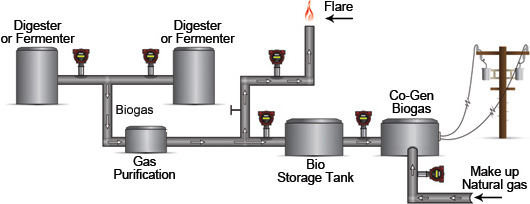
According to Al Locatelli, Co-Gen and Standby Generator Specialist, preparing this raw biogas into fuel for their internal combustion engines is no simple task, but it’s what makes Santa Cruz Wastewater Treatment Facility unique. Their Waukesha 7042 GLD 820KW engine, coined Cogeneration 1, burns a mixture of digester gas and purchased natural gas. The natural gas is mixed with air to lower the BTU levels closer to digester gas. This biogas enters a manifold system, goes through an iron sponge scrubber to remove hydrogen sulfide (H2S), a harmful greenhouse gas, and a chiller unit to remove the moisture from the gas. Compressed from 7 inches of water column to 3 psi, the gas enters a second carbon scrubber to remove siloxanes which can harm the engines.
In their static inline mixer controlled by a loop processor, this cleaned and compressed biogas is mixed with the diluted natural gas to maintain the optimal gas blend of 80% digester gas and 20% purchased natural gas. If the mass flow rate of digester gas decreases, more diluted natural gas enters the blend. Essentially the diluted natural gas compensates for the fluctuations in digester gas production, ensuring that very little digester gas has to be flared off. After passing through a particle filter, this mixed gas is finally ready to fuel up the Waukesha 7042 GLD engine. To improve engine performance, Locatelli explains that a high BTU shot of natural gas is injected into the pre-combustion engine chamber using admission valves to ignite the lean fuel mixture in the cylinders. Natural gas readings taken from the Flat-Trak Model 780S help Locatelli diagnose potential engine problems and tune the engine for increased efficiency. Although most of their biogas is used to fuel Cogeneration 1, sometimes, especially when Cogeneration 1 is down, the digester gas pressure increases and a pressure transducer loop processor automatically opens a valve to flare off the excess digester gas. For EPA reporting purposes, this flared gas is measured with Sierra’s Steel-Mass Model 640S. By reusing their methane, Santa Cruz Wastewater Treatment Facility prevents 41 tons of CO2 emissions from polluting our atmosphere, a potent greenhouse gas.
Each day, operators check the gas readings taken by the Flat-Trak Model 780S and Innova-Mass Model 240 which are connected to the Supervisory Control & Data Acquisition (SCADA) computer system, allowing them to manage this complex cogeneration system and trend historical data of gas usage. Working and relying on Sierra every day, Locatelli says, “from what I see from other vendors, Sierra is the top of the line.” He is even more pleased with the lack of maintenance problems. “We started using these meters in 2003 and have had no problems,” declares Locatelli.
Energy Savings—A Balancing Act
By using the sophisticated SCADA system and their Power Monitoring System, which automatically calculates their monthly energy bill, Dave Meyers, Senior Plant Operator, makes important energy saving decisions each day. Using about 1.3 megawatts, the plant can’t run solely on the 820kW produced by Cogeneration 1. Meyers explains that during the week, between Noon and 6pm Monday through Friday, May through October, energy rates jump from 11 cents a kilowatt hour to 11 dollars a kilowatt hour which includes on peak demand charges. To break these peak demand times, he decides to fire-up their Waukesha 3521 GLD lean burn engine, coined Cogeneration 2, which produces 500kW of energy, but runs solely on purchased natural gas. Meyers and other operators save Santa Cruz Wastewater Treatment Facility money on energy by choosing to pay for the natural gas to run Cogeneration 2 during peak demand times rather than importing energy from PG&E at $11 a kilowatt hour.
Conclusion
Sierra’s accurate mass flow measurements help quantify these savings by giving accurate mass flow rates of digester gas production, digester gas burned in the cogeneration system, and digester gas flared to the atmosphere all monitored by the Monterey Air Board twice a month.
“Experience Our Passion For Flow!™”
|