District Heating Promises Lowest Carbon Footprint
District heating is a system for distributing heat generated from a centralized location to be used for residential and commercial heating requirements such as space heating and water heating. The heat is often obtained from a cogeneration plant that burns fossil fuels, but increasingly these plants are transitioning to biomass. District heating plants can provide higher efficiencies and better pollution control than localized boilers. According to some research, district heating is the cheapest method of cutting carbon, and has one of the lowest carbon footprints of all fossil fuel generation plants.
Traditionally, many campuses, universities, hospitals, and corporations have estimated steam flow by measuring condensate or using turbine meters to measure the total output of steam generated and distributed to each building. In this era of rising energy costs, it is critical to have accurate steam usage numbers so that energy managers can control energy costs and bill end users. Facility managers have long known that the condensate method lacks accuracy. In addition, the rotors on turbine meters tend to break, thus requiring annual replacement—a costly and timeconsuming process. A more effective method of steam measurement was needed to tackle the energy challenges that lay ahead.
The Sierra Solution
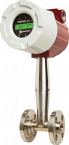
With the capability of measuring five flow parameters with one process connection and calculating true mass flow directly with integral temperature and pressure sensors, Sierra’s InnovaMass vortex meters provide an optimal solution. Sierra was the first to invent a mass vortex flow meter in the late 1990's. By capturing over 80% of the district energy market worldwide in the last decade, Sierra’s InnovaMass has become the “steam meter” for industry. As a member of the International District Energy Association (IDEA), Sierra has also played a leading role in improving district energy technology.
The InnovaMass installation at the University of Toledo is an example of one of thousands of successful applications. The University has installed eleven InnovaMass meters throughout the UT campus. They are now able to effectively measure the total steam output from their central steam plant and sub-meter the amount of steam to each building in order to know the exact steam consumption generated and distributed throughout the campus.
Here’s what makes Sierra’s InnovaMass® an ideal choice:
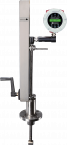
» Insertion available for economical installation on large pipe sizes up to 72”
» Direct measurement of five process variables (pressure, temperature, mass flow,
volumetric flow, density)
» 30:1 range
» Fully field configurable
» Onboard diagnostics
» No moving parts
» Loop powered