Go to Flow Division >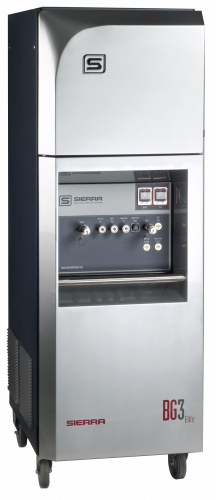
Partial Flow Dilution (PFD) System
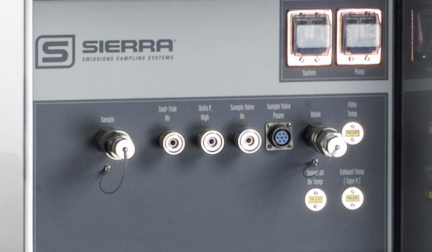
BG3 Elite
- Transient and steady-state sampling
- Use in place of CVS for emissions and analytical sampling
- Light-duty and heavy-duty engines
- Sample any size or type of engine and any fuel
- US EPA-approved for R&D and certification work
- BG3 with ExhaustTrak replaces full flow CVS for Light Duty- Learn more
- Made in the USA
Overview
The BG3 Elite is a high performance next generation transient Partial Flow Dilution (PFD) system ideally suited for gravimetric sampling of engine exhaust Particulate Matter (PM). Used widely for new engine research and development, the BG3 Elite is also used for engine certification work.
Major Breakthrough
Joining BG3 Elite with Sierra’s ExhaustTrak Direct Raw Exhaust Flow Meter creates a major breakthrough as a “Dynamic Duo” is formed. BG3 Elite and ExhaustTrak, working together, are a technically equivalent, commercially available replacement of full flow CVS systems for partial flow PM and raw or dilute gaseous emissions sampling methods for Light Duty. Learn more...
BG3 Elite provides the accurate and repeatable Partial Flow Dilution (PFD), but it needs ExhaustTrak to resolve temporal and dispersion flow rate offsets versus intake air by measuring real time mass flow at the emissions sampling zone.
Regulatory Compliance
- EPA 40 CFR Parts 1065, 1066, 92, 89
- ECE R49: Rev 3, 04 Series, Rev 4, 05 Series, Rev 5, 05 Series, Rev 6, 06 Series
- Global Test Regulation (GTR) No.4
- Directive 97/68 EC at last amended 2011/88/EC
- ECE R96, Rev 2, 01
- ISO 16183 (2002), ISO 8178-1 (1996, 2006, 2017), ISO 8178-11(2006)
- Japan JE05
- Plus: all related or derivative regulatory documents and standards not directly mentioned.
Automatic Filter Changer
More About BG3 Elite
BG3 Elite is refined for applications requiring 47mm filter media such as Part 1065, and combines smaller, more precise flow control valves and flow measurement components with an upgraded pressure transducer suite to build on its industry-leading technology base. BG3 Elite is the most widely used PFD systems boasting an installed base of more than 300 units globally. On January 7, 2011, the BG3 PFD was signed into law and is now included in the United States Federal Register as a legally recognized alternative method to CVS.
BG3 Elite is used for proportional sampling on transient test cycles with any fuel (diesel, gasoline, natural gas, etc.) and can be used on engines of any size in both engine and chassis test cells. BG3 Elite is also equally effective for steady-state test cycle PM measurements.The Elite is available in a 65 slpm version and a 100 slpm version to cover a broad range of PM sampling needs. Sierra-CP’s proprietary Cadet V14 software is being introduced on the Elite product, along with a patented feature that actively controls diluted sample to an off-board measurement device while simultaneously maintaining Part 1065-required metrics for proportionality and filter face velocity required for gravimetric sampling.
The system can also be used as a diluter for particle sizing instrumentation and for gaseous emissions measurement systems, while simultaneously and accurately sampling particulate matter.
Steady-State and Transient Sampling
Steady-state sampling times range from two to five minutes depending on the relative particulate emissions output of the engine and the size of the filter holder used. Test cycles for any regulation can be easily designated, set up, and run. BG3 satisfies all ISO 8178, ISO 16183 and 40CFR 1065 requirements for transient and steady-state equivalency, as well as EPA requirements for non-road steady-state (CFR Part 89), supplemental 13-mode and ramp modal cycle testing.
Deep Roots in HD Diesel PM Sampling
Since the early 1990's, Sierra has long been a leader in the field of heavy duty diesel particulate matter sampling science through its “BG-X” series of partial flow sampling and dilution systems (“PFDS”), with the BG3 transient PFDS as the flagship system. When tracing the evolution of the BG-X from the first BG1 design to the class-leading BG3, there has been no shortage of highlights in the program, including the first known alternate system approval granted by USEPA to a PFDS for 40 CFR Part 86 transient cycle certification.
United States EPA Approval
The BG3 Elite PFD (Partial Flow Dilution) system is protected by nine patents with several others pending. BG3 Elite is the recognized standard in the industry for PFD sampling. On January 7, 2011, PFD was signed into law and is now included in the United States Federal Register as a legally recognized alternative method to CVS. BG3-CVS correlation results from a two-year program involving two laboratories, six engines and two BG3 systems (EPA-HQ-OAR-2010-0142-0003), the USEPA granted approval of PFDS for certification of engines on all transient test cycles (40CFR Part 1065.140(d)(1)(i-vi, inclusive). By acknowledging the correlation to CVS, as demonstrated by BG3, the 1065 approval freed heavy duty diesel engine manufacturers from the flexibility constraints of CVS and enabled broader use of PFDS for diesel particulate filter (“DPF”) efficiency research, DPF loading mapping, engine and DPF deterioration studies, and diesel engine certification. The Direct Final Rule (DFR) contains, among other things, the unprecedented allowance to use PFD for engine emissions PM transient certification testing. Learn more...
Product Benefits
- Protected by 13 United States Patents
- Documented gravimetric correlation to CVS
- Any size/type engine, any fuel
- Outstanding transient sampling fidelity
- Uses our proprietary CADET V14 control software for excellent flexibility & precision control
- Interface AirTrak intake air mass meter
- Interface ExhaustTrak raw exhaust mass meter
- Interface AFC automatic filter changer
- Supports light-duty bag sampling and Euro6 PN
- Approximately 1/10th of HD CVS system cost of ownership
- Approximately 1/100th to 1/1000th the annual energy usage of HD CVS
- Patented PFD (Partial Flow Dilution) tunnel has ultra-low particulate loss and requires no cleaning with proper operation
- Outstanding integrity of internal flow systems via proven proprietary daily mirror calibration method
- Yields excellent accuracy and repeatability over a wide range of dilution ratios
- Portable from cell to cell to maximize flexibility and ROI
- Ability to accurately measure PM either pre and post catalyst and/or DPF for research or DF testing
Installation & Facility Requirements
Sierra works closely with each customer before, during, and after the installation and commissioning of the BG3, ensuring a smooth system launch and ongoing customer satisfaction.
Installation:
- An on-site Sierra engineer performs all commissioning and training services to achieve high customer satisfaction
- Since the BG3 is portable, it is set up quickly in any configuration of engine and test cell environment
- During commissioning, the Sierra engineer calibrates the BG3 with certified calibration equipment
- Sierra sends a specification sheet to pre-empt future questions or problem
Facility Requirements:
- Input power of 110 VAC, 20 amp (2 each), 50/60 Hz
- Clean supply of dry air at 80 psi minimum to 100 psi maximum - Sierra assists each customer so that shop air is optimal for BG3 operation
- The BG3 is located within the test cell - The space required to accommodate the cabinet is 24 inches W x 36 inches D x 72 inches H
- The BG3 has a 19 inch rack mount PC and a 17 inch plasma screen monitor that can be remotely placed in the control room of the test-cell
Collecting a Sample
Four Step Sample Collection:
Step 1: Load the Filters.
Insert the sample filter pair into the filter holder or load the filter Multi-Changer cassette.
Step 2: Set-up the Test.
Enter the appropriate flow sample parameters into the test set-up screen.
Step 3: Collect the Sample.
Press the standby button, the BG3 automatically collects the sample.
Step 4: Sample Complete.
Remove filter pairs for PM mass measurement. A filter weight calculation sheet is available for the engineer’s convenience.
Data Quality Assurance
The highest possible data quality is generated through sophisticated software and hardware in four key areas.
1) Patented T- DAC™ Technology.
Allows the speed of the dilute mass flow controller to correctly correlate the sample flow with the actual engine exhaust mass flow.
2) Sample Flow Rate Confirmation.
A third mass flow meter confirms the sample flow rate by comparing the measured flow to the set flow of the BG3. This serves as a Go/No Go sample flow check before each test.
3) Validation.
The Model BG3 continuously controls and validates all critical operational and calibration data parameters and readings during each test. Engineers can make decisions during and after a test.
4) Calibration.
- Fully automated daily calibration between each test.
- Fully automated leak check
- Filter face velocity (sample mass flow rate) for filter size
Software and User Interface
Based on our flagship CADET Automation Software platform, the BG3 control software is a user friendly application that allows the engineer to work independently of a host system or interfaced with a host. The BG3 software allows the knowledgeable engineer the diversity of testing any size of fueled engine for particulates, as well as perform calibration and troubleshooting. The user can collect PM samples during test programs and allow remote control of the BG3 by a host PC. The BG3 system and software is designed to allow novice users to easily collect accurate particulate samples, however it is recommended that users should have:
- Some experience in the operation of engine emissions measurement systems
- Engine test stand and/or chassis test cell experience
- A basic understanding of Microsoft Windows based computers and text processing
Specifications
- Filter Size: 47 or 70mm standard (90mm available)
- Single filter holder, Triple head filter, or Automatic filter changer AFC 14 and 22 filter puck canisters
- Range: Any size engine, regardless of RPM or stack diameter.
- Sample Flow Accuracy: Less than +/- 3% at dilution ratios of 15:1 or below.
- System working standard flow measurement accuracy: Less than 1% of reading
- QC Sample flow check meter flow accuracy (optional): <3% of reading at 20-50%FS, <2% of reading at 50-100% FS.
- Sampling Time: A nominal sampling time of 2 to 5 minutes per mode is recommended for single filter/ mode testing on a 0.1g/hp/hr 8- mode cycle-weighted emissions engine when using 70mm test filters. The sampling time depends on the precision of the microbalance used and the brake specific emissions output of the engine being evaluated. Up to 20 minutes per mode or more may be required for PM sampling from engines where PM after treatment is used.
- Input Power: 110 or 220 VAC, 50/60 Hz (Indicate at time of order).
- Dilution Air Supply: 90 PSI, 3.5 CFM (6.2 bar, 6 m3/hr).
- Internal Sample Update Rate: 80Hz.
Technical Description
The fundamental description of BG3 Elite, per ISO8178-1 (5) is as a “partial flow dilution system with flow control and total sampling”, otherwise known as a ‘split, then dilute” methodology.
The operational difference between BG3 and CVS is that a CVS first dilutes the full flow of raw exhaust and then collects PM from a small fraction of that flow (dilute, then split), while the BG3 first proportionally extracts and then dilutes a small fraction of the raw exhaust and then collects PM on a gravimetric filter from that flow (split, then dilute).
The BG3 design premise is to provide equivalent results to CVS by maintaining proportionality of the raw exhaust sample mass flow relative to the exhaust mass flow rate of the engine.The primary purpose of BG3 is to control the flow rate of a representative sample of exhaust during an engine test cycle where engine speed, load, airflow and fuel flow values exhibit high rates of change over very short time frames. The magnitude of engine inlet air mass flow excursions can approach 10:1 within less than two seconds.
The challenge for any PFD technology is to maintain constant proportional flow from an exhaust stream with a highly variable mass flow rate throughout a typical test cycle. In order to ensure that the total mass of particulate trapped at the filter is equivalent to that obtained by the use of a full flow CVS, the sample flow rate must be controlled in real-time to be proportional to the exhaust mass flow. Further, it is necessary to control this sample flow rate to ensure that the filter temperature does not exceed the regulatory defined limit while the dilution air temperature is maintained in the range required by the regulations.
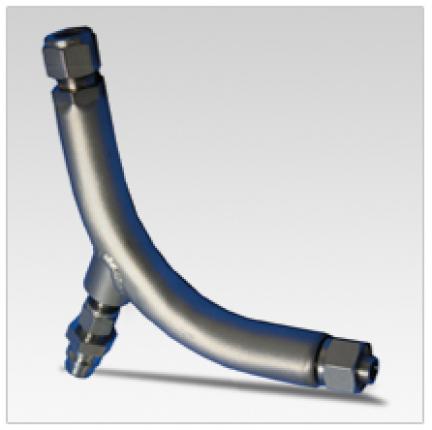
Near Zero-Loss Dilution Tunnel: The magic of BG3 technology is the patented dilution tunnel which eliminates the major achilles heel of any PFD, the deposition of particulate on dilution chamber walls as the diluted exhaust sample is transferred to the filter from the raw exhaust stream.
Ultra low particulate loss in the patented radial inflow partial flow dilution tunnel and a very short equilibration zone before the filter set the BG apart from all other PFSS. Sierra’s patented dilution tunnel technology is a chamber under pressure. Conditioned dilution air permeates from the outside of the chamber in through the walls of a sintered metal tube carrying the diluted sample, creating a hydrocarbon-free air barrier. This eliminates the effect of the dilution system’s “history” on the test sample.BG3 is an integrated product that incorporates two flow devices supplying and extracting gas used in the dilution tunnel design. The mass flow of raw exhaust sampled at the probe is the difference between the flow rates of the dilution and total mass flow meters. This sample flow is calculated as the difference between the total and dilute flow.
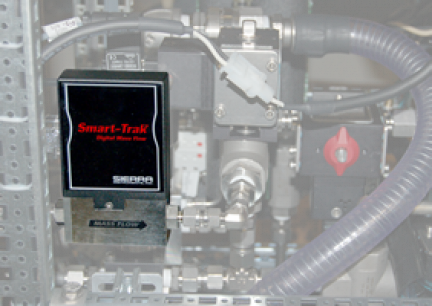
Filter Sampling Temperature Control
Sierra's particulate sampling temperature control system is built to meet US EPA 40CFR Part 1065 regulations. The system takes the diluted exhaust sample through a cyclonic separator and controls the temperature and residence time to the filter face. The cyclonic separator is strategically placed to drop out the larger particulates prior to entering the one second residence chamber. The temperature is highly controlled and measured within 6-inches of the filter holder.
- Meets EPA 1065 Regulation
- Plug-and-play with BG3 partial flow sampler
- Used in manual mode with other devices
- Adapt to an automatic filter changer
- Maintains 47 Deg. C within +/- 2 Deg. C