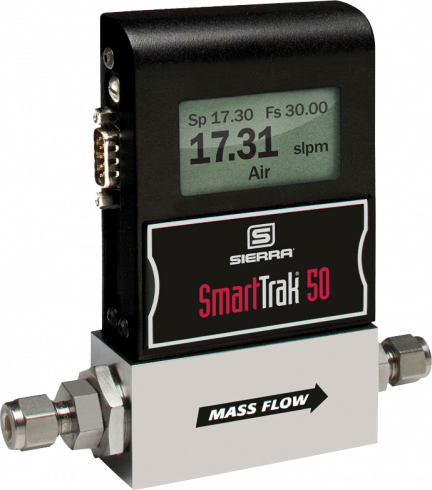
Low-Cost Digital Mass Flow Controllers & Mass Flow Meters
SmartTrak® 50
- OEM pricing with digital high-performance
- Small footprint at 50 slpm ideal for OEMs
- 5-point NIST calibration on primary standards
- Large display to view flow information easily
- Choice of construction in aluminum or 316 stainless-steel
Overview
For lab researchers and systems integrators/OEMs, the SmartTrak 50 is a low-cost mass flow meter and gas controller that shares the same accuracy and repeatability as the flagship SmartTrak 100 with a few less features and slightly larger footprint—but at a more economical price.
The SmartTrak 50 series of meters and gas controllers is designed to deliver smooth, stable, accurate, and repeatable gas mass flow control you can rely on, every time. Unaffected by upstream gas temperature and pressure fluctuations, gas mass flow control is direct and unequivocal.
How is a gas mass flow meter calibrated?
A mass flow controller should have a strong and flexible mass flow control valve with accessible PID valve tuning to ensure the best speed and reliability. Sierra’s SmartTrak 50 features NIST traceable accuracy backed by a 10-point primary standard calibration over the entire flow range.
Prefer to calibrate your own digital flow meters and mass controllers in-house? Sierra provides all necessary software and training, and even the flow calibration standards required for the job.
Software: Free user software is provided with every unit.
Special Pricing: We work with you to meet budget requirements and cost targets. Ask about OEM volume discounts.
Achieve unmatched precision: Watch "How It Works" Video.
View: Capillary Tube Thermal Mass Flow Meters & Mass Controllers - A User's Guide
Accuracy and application flexibility result from:
- Thermal mass flow technology provides direct mass flow
- A patented, inherently linear Laminar Flow Element (LFE) design
- Advanced platinum-wound capillary sensor technology
- Proprietary frictionless, hovering control valve
Rule-of-Four Calibration: The ONLY Guarantee of Accuracy!
At Sierra, we have a saying: “Instrument accuracy is only as good as its calibration.”
Sierra is one of few manufacturers today that perform a detailed 10-point calibration across the entire mass flow range. We strictly adhere to using primary standards and the NIST “rule of four”. This means our gas flow primary standards are required to be four times more accurate than the device under test.
This “rule of four” is Sierra’s calibration bedrock and absolutely essential for the quality you demand. When researching your next MFC, ask about calibration.
Product Benefits
|
|
Specifications
View All Specs: |
|